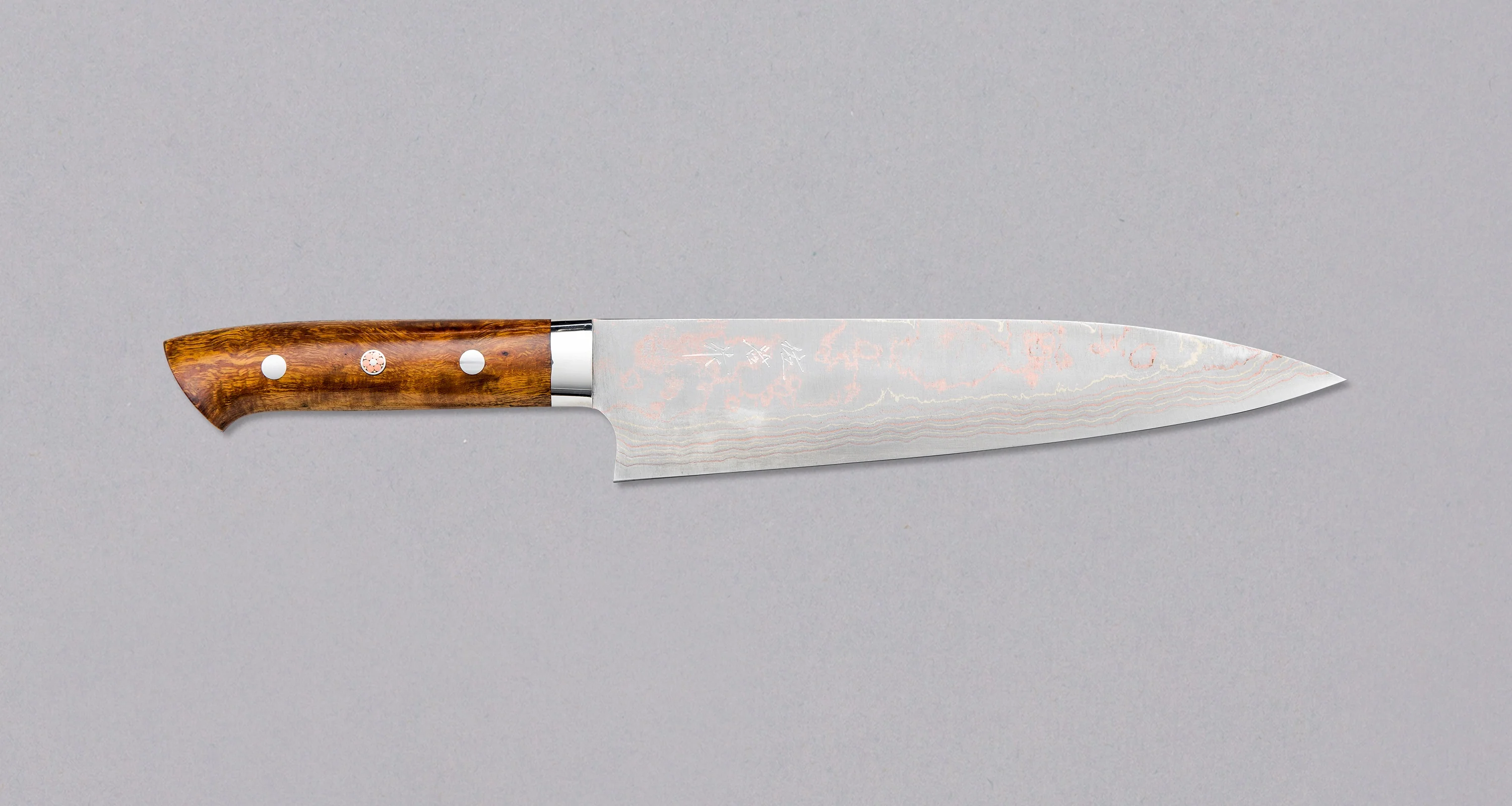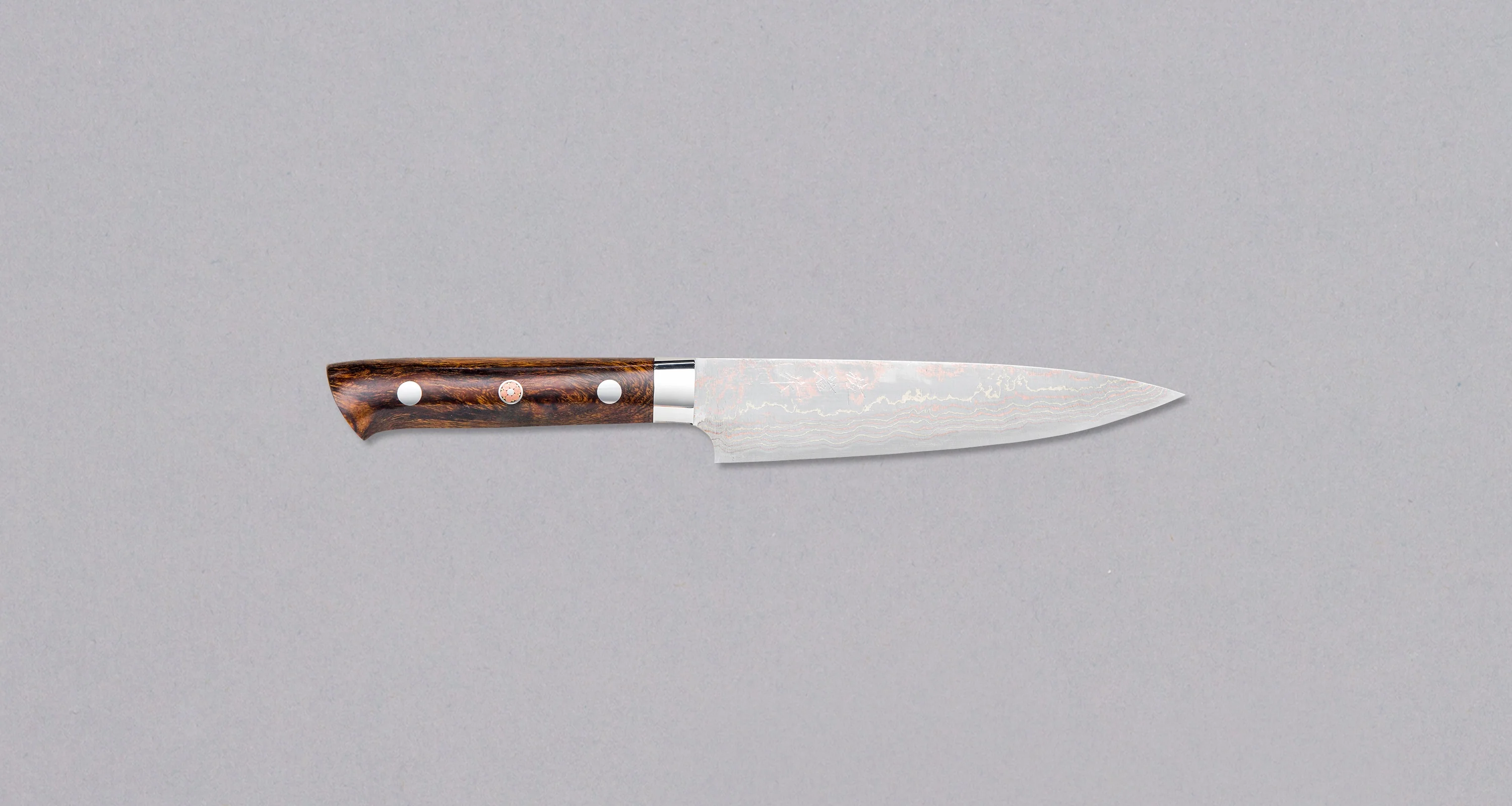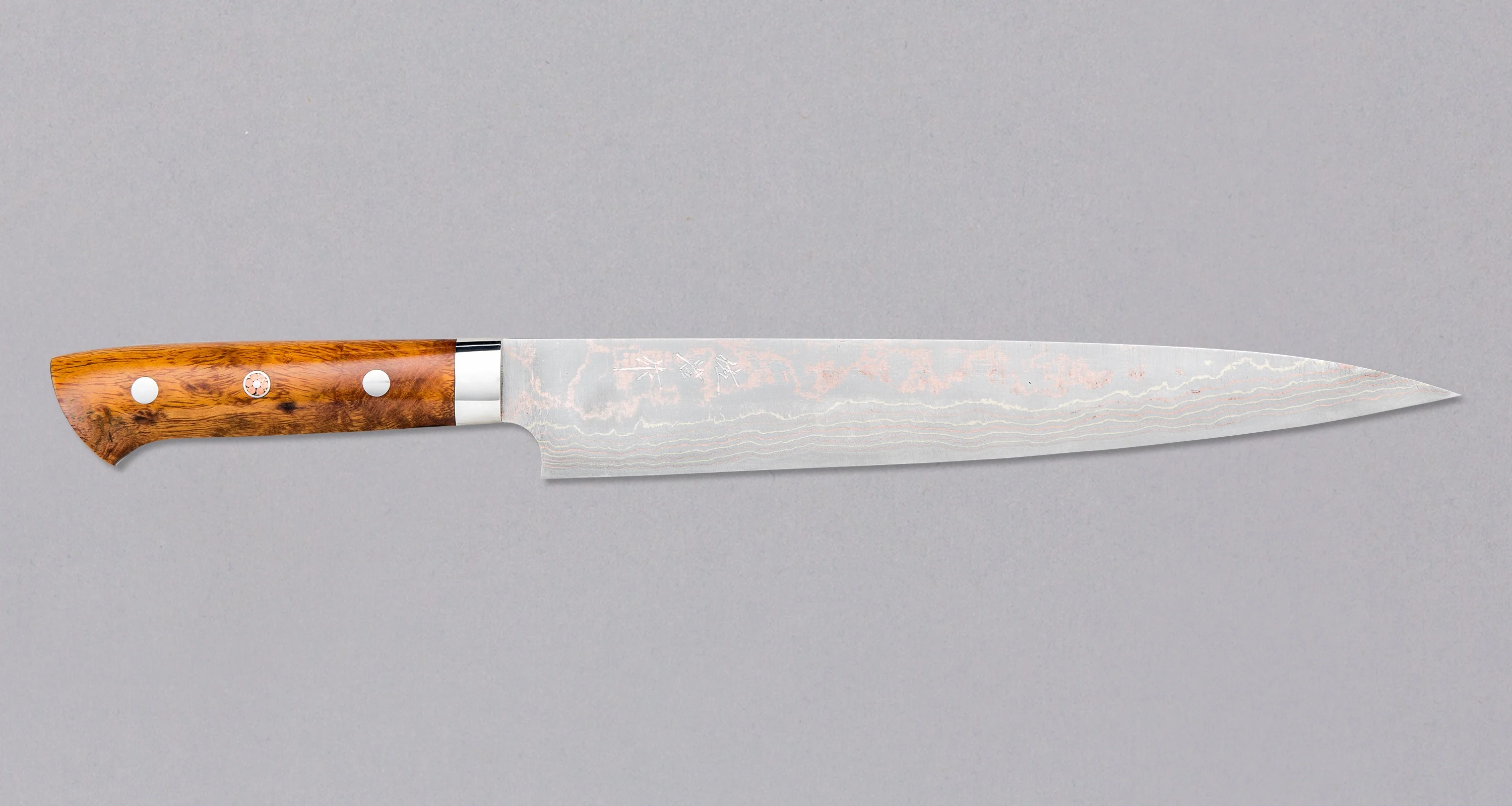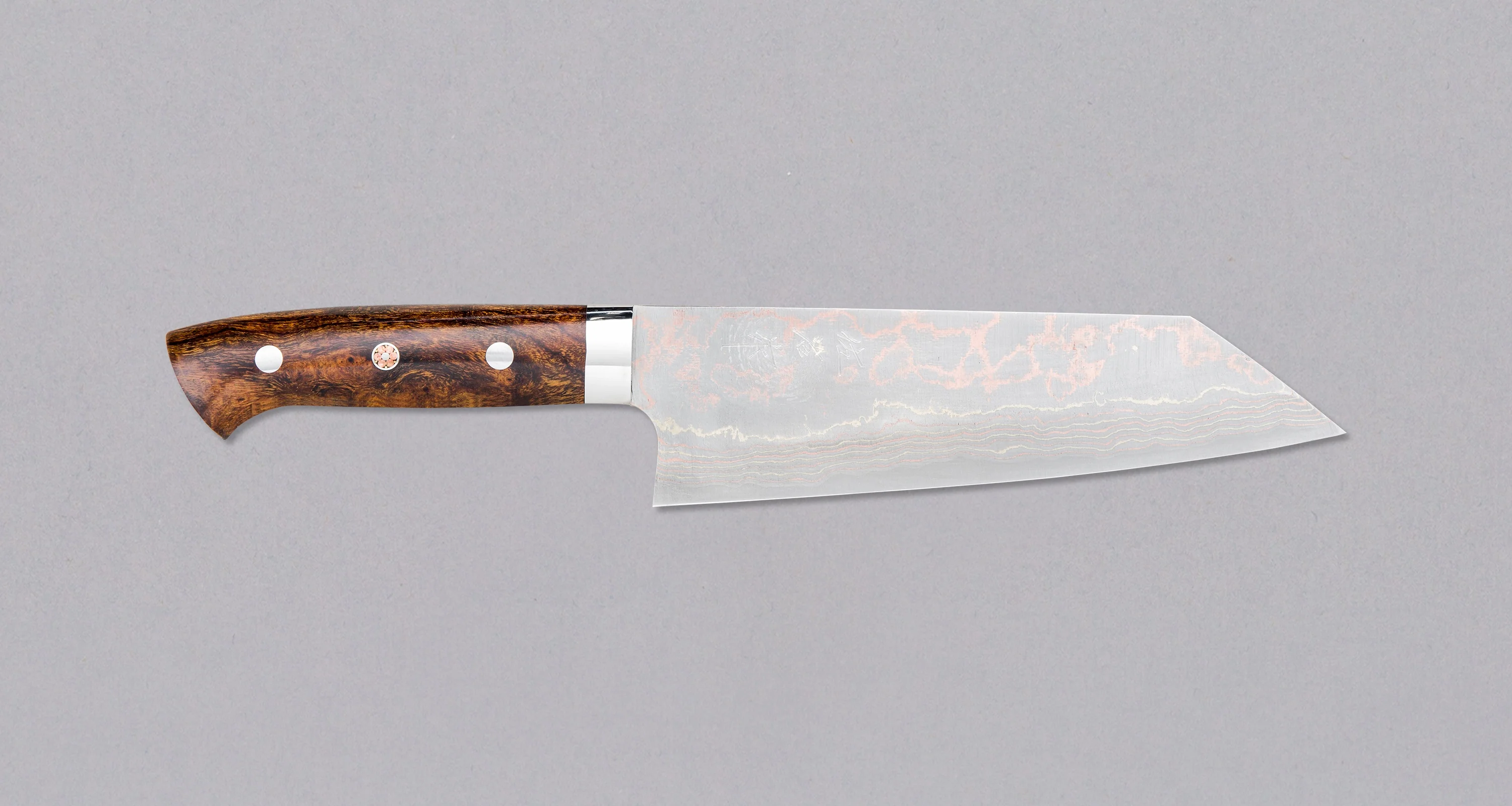
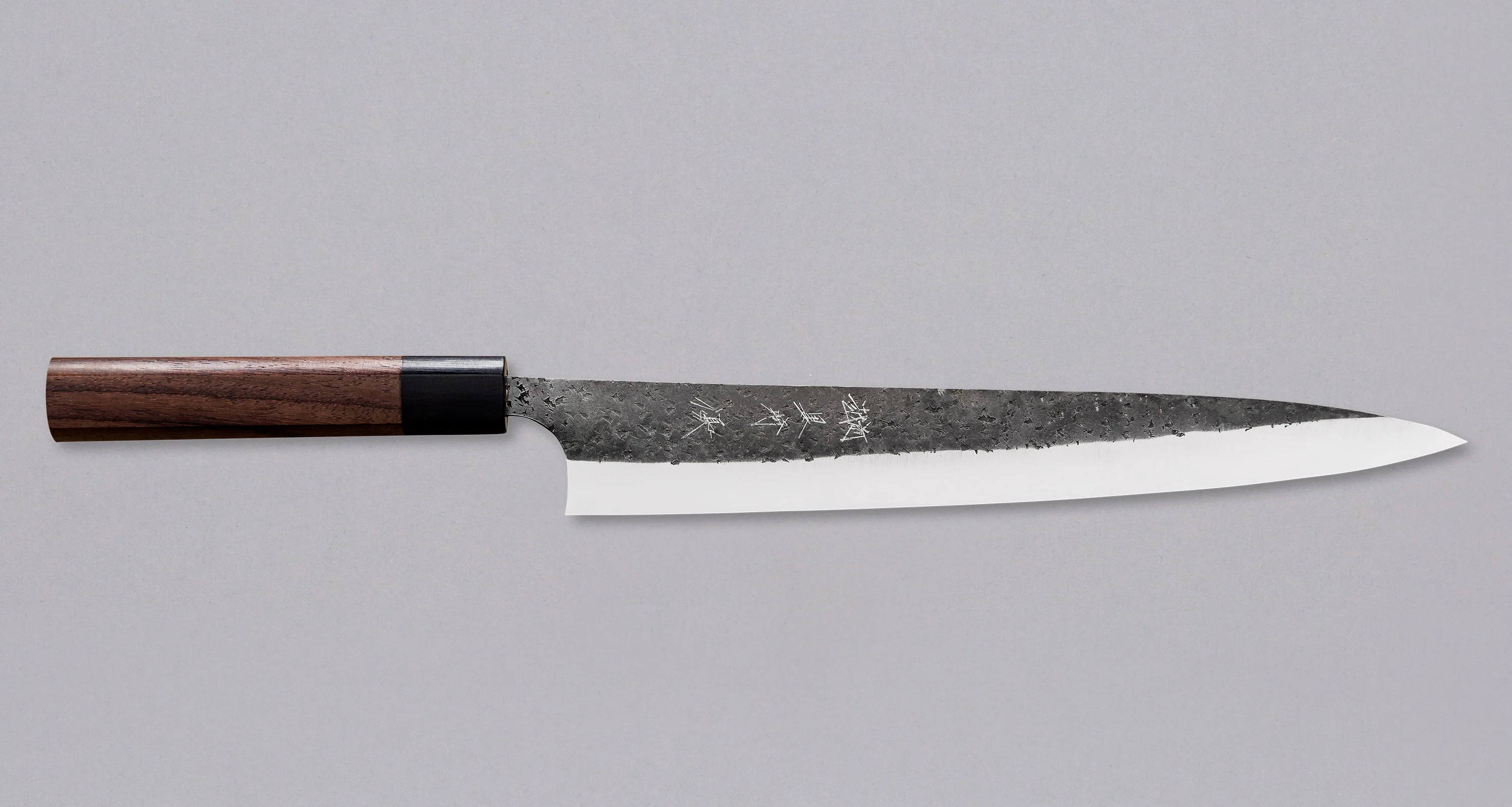
Yu Kurosaki Sujihiki Kuro-uchi 270mm (10.6")
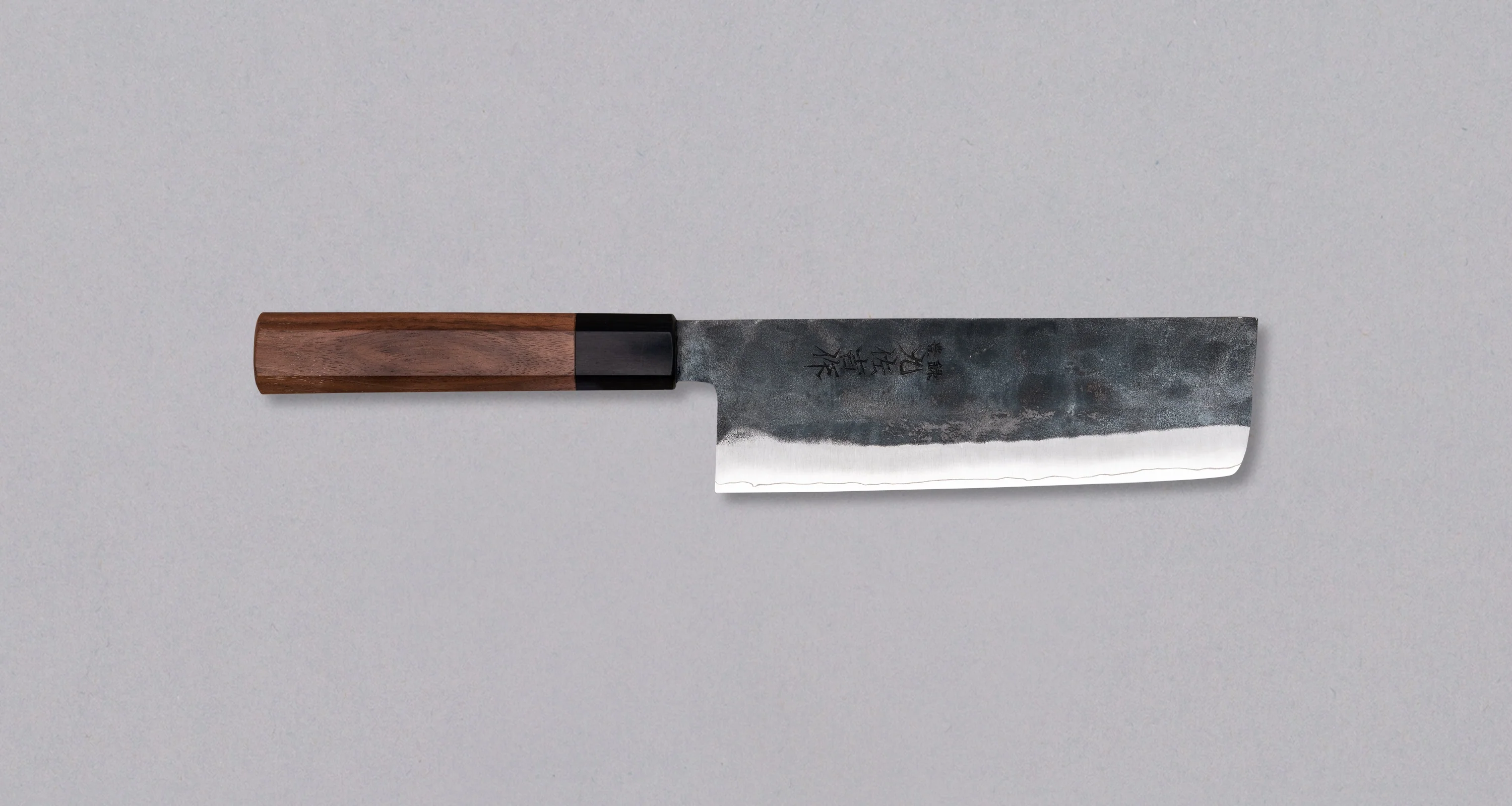
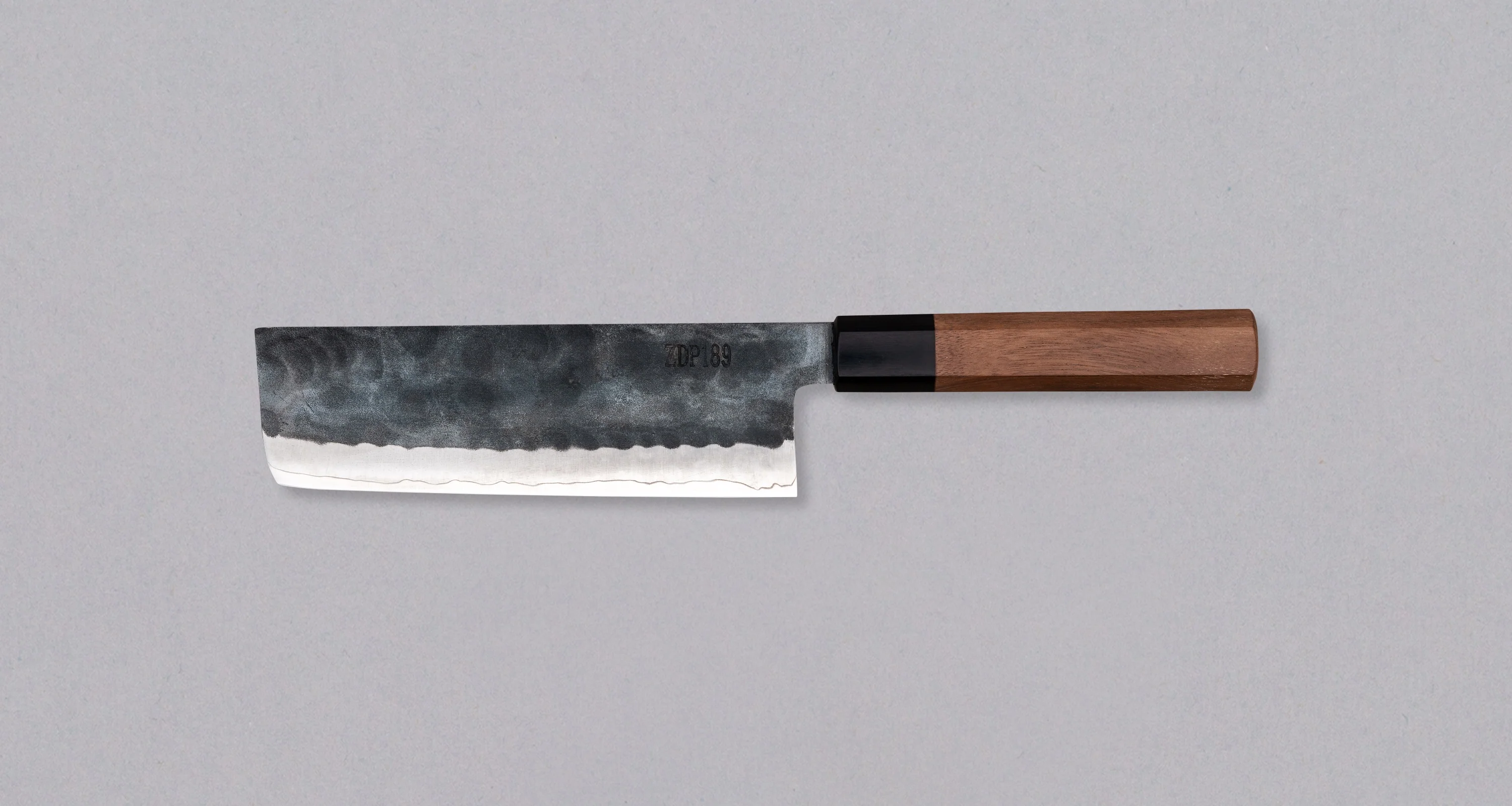
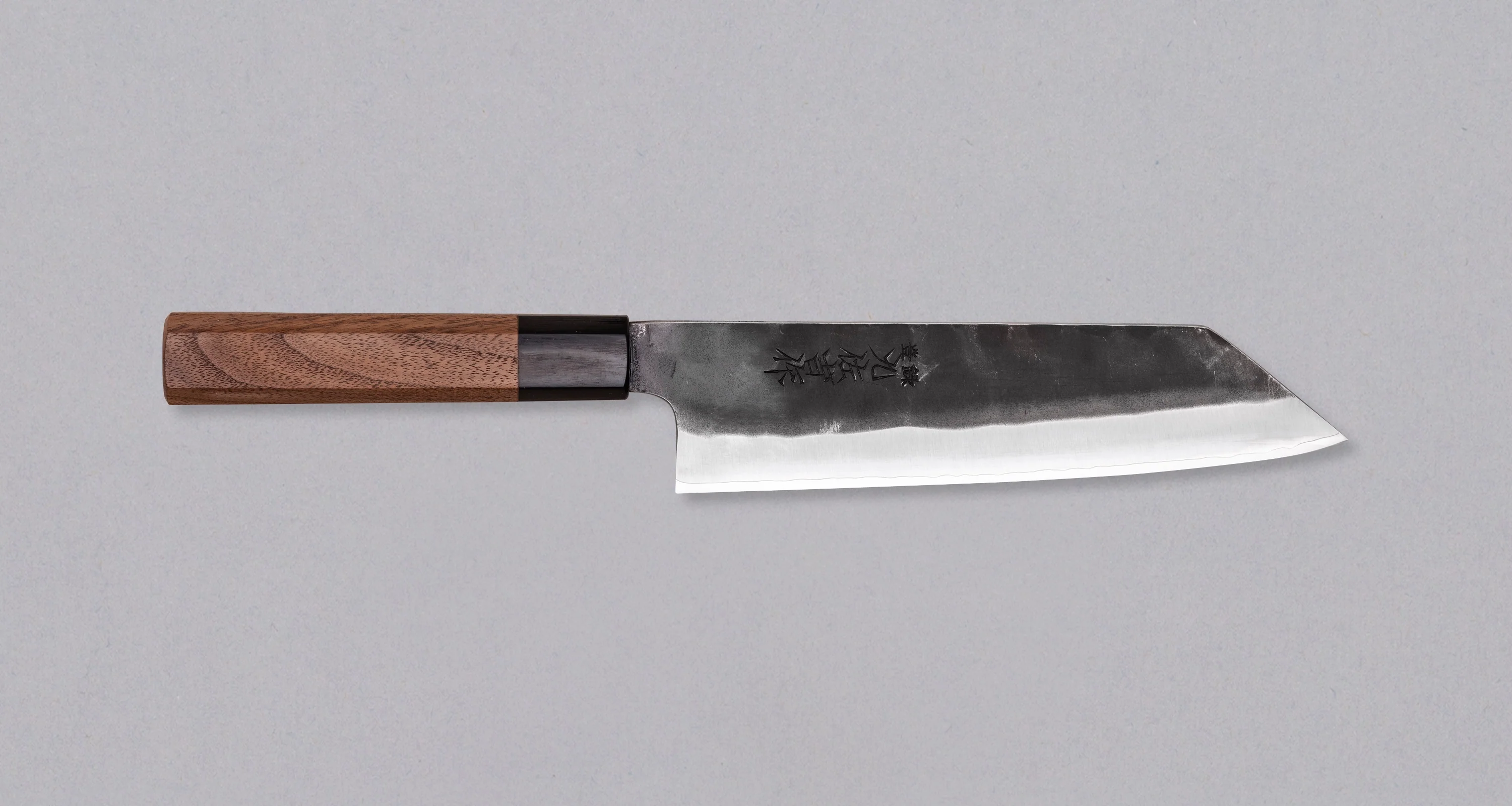
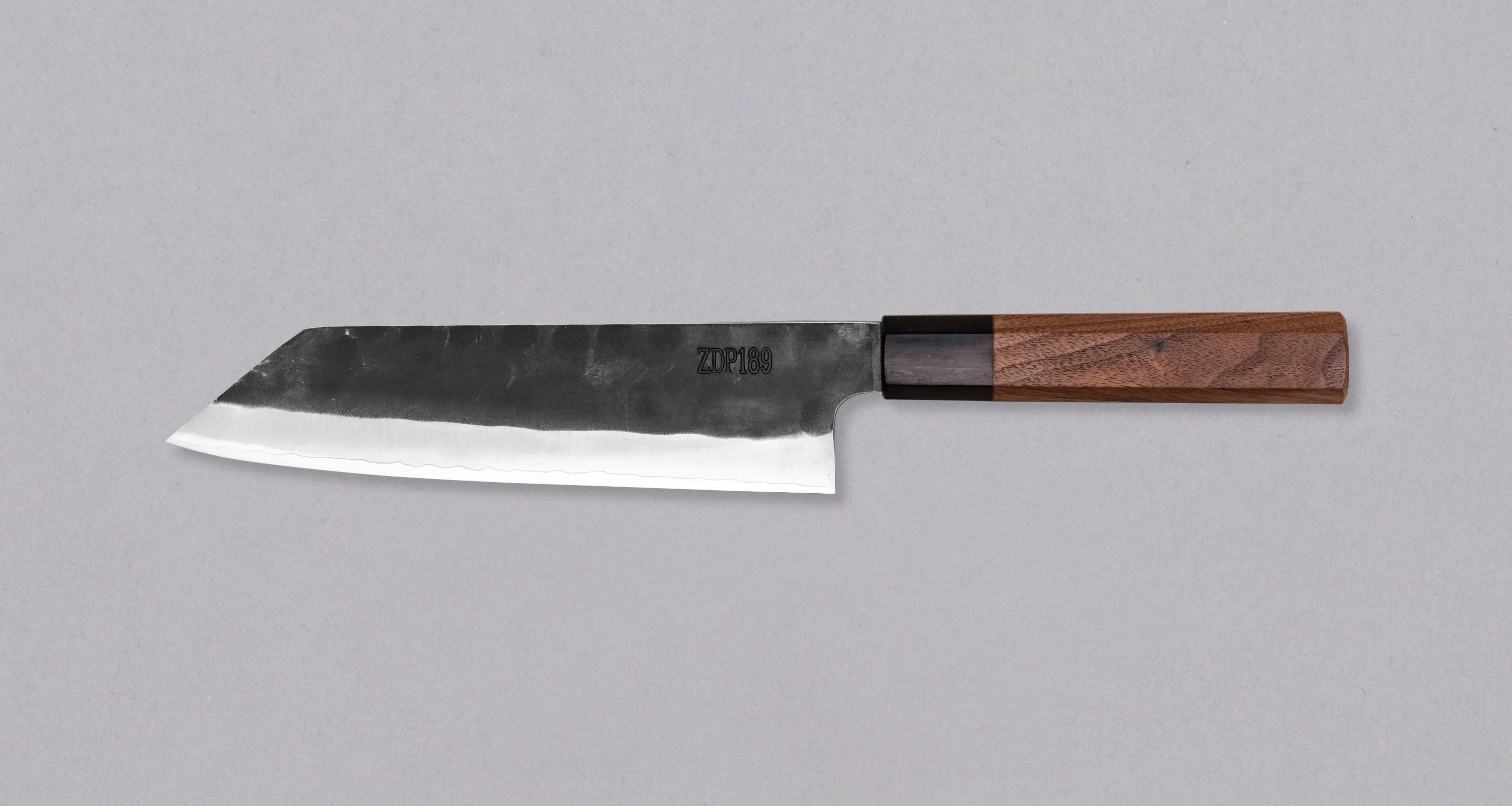
Every Kurosaki blade carries his signature: a pattern of hammered "water droplets" across the steel, and like snowflakes, no two are alike. The knife you receive exists exactly once.
The sujihiki is Japan's slicing knife — a long, narrow blade built for clean, single-pull cuts through meat and fish. At 270mm it carves a roast, portions a fillet, or slices sashimi in one smooth draw, so each cut surface stays glossy and intact. If proteins are a serious part of your cooking, this is the knife that finishes the job beautifully.
Why this knife works the way it does
- Aogami Super core — One of the most respected high-carbon steels in Japan. It takes an exceptionally fine, almost gentle edge, holds it for a long time, and resharpens easily when the day comes. The trade-off: the exposed core near the edge develops a patina with use and likes to be kept dry — more on this below, it's easier than it sounds.
- San-mai stainless cladding — The carbon core is sandwiched between two stainless layers, so most of the blade is protected from rust. Carbon-steel cutting performance with a fraction of the carbon-steel maintenance.
- Long, narrow geometry — The 270mm length lets you slice in one continuous draw instead of sawing, while the narrow, thin blade glides through with minimal friction. Together they're why cuts off a sujihiki come away glossy and intact, not torn.
- Kuro-uchi finish — The dark upper blade is the untreated forge surface: an already-formed protective layer that shields the steel beneath and gives the knife its traditional look.
- Hammered tsuchime surface — Kurosaki's trademark dents aren't decoration alone; they create air pockets so thin slices release from the blade instead of clinging to it.
- Octagonal rosewood handle, black pakka wood ferrule — Light and precise in the hand, balanced for long, controlled drawing cuts.
Good to know before buying
- This is a hand-forged knife. Slight variations in the grind, finish, and hammer pattern between pieces are the nature of the craft — and the point of it.
- The exposed Aogami Super edge will develop a grey-blue patina with use. This is natural and protective, not rust. Keep the blade dry after washing and oil it occasionally.
- The kuro-uchi coating softens and wears gradually with use. Normal, and part of how the knife ages with you.
- A sujihiki is a slicer, not a cleaver: no bones, no frozen food, no twisting in the cut. Long and thin means precise — and deserving of a little respect.
- At 270mm, make sure your cutting board and knife storage can accommodate the length. A fitted saya is the safest way to store or transport it.
About Yu Kurosaki
Yu Kurosaki forges in Takefu Knife Village near Echizen, where more than ten master blacksmiths work in open view of visitors. He apprenticed under Hiroshi Kato — a smith with over fifty years at the forge and one of the Village's founders — before opening his own smithy. He is the youngest blacksmith ever granted the title of Master Nokaji by the Takefu Knife Village Association, where he now teaches as senior instructor.
His knives are sought after worldwide and we receive them in small batches. If this one is in stock, it won't be for long.
☝️ Visiting Japan? Put Takefu Knife Village on your itinerary — you can watch the forging up close.
Here's a short video from Kurosaki's workshop:
Original: $270.00
-65%$270.00
$94.50Yu Kurosaki Sujihiki Kuro-uchi 270mm (10.6")
Every Kurosaki blade carries his signature: a pattern of hammered "water droplets" across the steel, and like snowflakes, no two are alike. The knife you receive exists exactly once.
The sujihiki is Japan's slicing knife — a long, narrow blade built for clean, single-pull cuts through meat and fish. At 270mm it carves a roast, portions a fillet, or slices sashimi in one smooth draw, so each cut surface stays glossy and intact. If proteins are a serious part of your cooking, this is the knife that finishes the job beautifully.
Why this knife works the way it does
- Aogami Super core — One of the most respected high-carbon steels in Japan. It takes an exceptionally fine, almost gentle edge, holds it for a long time, and resharpens easily when the day comes. The trade-off: the exposed core near the edge develops a patina with use and likes to be kept dry — more on this below, it's easier than it sounds.
- San-mai stainless cladding — The carbon core is sandwiched between two stainless layers, so most of the blade is protected from rust. Carbon-steel cutting performance with a fraction of the carbon-steel maintenance.
- Long, narrow geometry — The 270mm length lets you slice in one continuous draw instead of sawing, while the narrow, thin blade glides through with minimal friction. Together they're why cuts off a sujihiki come away glossy and intact, not torn.
- Kuro-uchi finish — The dark upper blade is the untreated forge surface: an already-formed protective layer that shields the steel beneath and gives the knife its traditional look.
- Hammered tsuchime surface — Kurosaki's trademark dents aren't decoration alone; they create air pockets so thin slices release from the blade instead of clinging to it.
- Octagonal rosewood handle, black pakka wood ferrule — Light and precise in the hand, balanced for long, controlled drawing cuts.
Good to know before buying
- This is a hand-forged knife. Slight variations in the grind, finish, and hammer pattern between pieces are the nature of the craft — and the point of it.
- The exposed Aogami Super edge will develop a grey-blue patina with use. This is natural and protective, not rust. Keep the blade dry after washing and oil it occasionally.
- The kuro-uchi coating softens and wears gradually with use. Normal, and part of how the knife ages with you.
- A sujihiki is a slicer, not a cleaver: no bones, no frozen food, no twisting in the cut. Long and thin means precise — and deserving of a little respect.
- At 270mm, make sure your cutting board and knife storage can accommodate the length. A fitted saya is the safest way to store or transport it.
About Yu Kurosaki
Yu Kurosaki forges in Takefu Knife Village near Echizen, where more than ten master blacksmiths work in open view of visitors. He apprenticed under Hiroshi Kato — a smith with over fifty years at the forge and one of the Village's founders — before opening his own smithy. He is the youngest blacksmith ever granted the title of Master Nokaji by the Takefu Knife Village Association, where he now teaches as senior instructor.
His knives are sought after worldwide and we receive them in small batches. If this one is in stock, it won't be for long.
☝️ Visiting Japan? Put Takefu Knife Village on your itinerary — you can watch the forging up close.
Here's a short video from Kurosaki's workshop:
Product Information
Product Information
Shipping & Returns
Shipping & Returns
Description
Every Kurosaki blade carries his signature: a pattern of hammered "water droplets" across the steel, and like snowflakes, no two are alike. The knife you receive exists exactly once.
The sujihiki is Japan's slicing knife — a long, narrow blade built for clean, single-pull cuts through meat and fish. At 270mm it carves a roast, portions a fillet, or slices sashimi in one smooth draw, so each cut surface stays glossy and intact. If proteins are a serious part of your cooking, this is the knife that finishes the job beautifully.
Why this knife works the way it does
- Aogami Super core — One of the most respected high-carbon steels in Japan. It takes an exceptionally fine, almost gentle edge, holds it for a long time, and resharpens easily when the day comes. The trade-off: the exposed core near the edge develops a patina with use and likes to be kept dry — more on this below, it's easier than it sounds.
- San-mai stainless cladding — The carbon core is sandwiched between two stainless layers, so most of the blade is protected from rust. Carbon-steel cutting performance with a fraction of the carbon-steel maintenance.
- Long, narrow geometry — The 270mm length lets you slice in one continuous draw instead of sawing, while the narrow, thin blade glides through with minimal friction. Together they're why cuts off a sujihiki come away glossy and intact, not torn.
- Kuro-uchi finish — The dark upper blade is the untreated forge surface: an already-formed protective layer that shields the steel beneath and gives the knife its traditional look.
- Hammered tsuchime surface — Kurosaki's trademark dents aren't decoration alone; they create air pockets so thin slices release from the blade instead of clinging to it.
- Octagonal rosewood handle, black pakka wood ferrule — Light and precise in the hand, balanced for long, controlled drawing cuts.
Good to know before buying
- This is a hand-forged knife. Slight variations in the grind, finish, and hammer pattern between pieces are the nature of the craft — and the point of it.
- The exposed Aogami Super edge will develop a grey-blue patina with use. This is natural and protective, not rust. Keep the blade dry after washing and oil it occasionally.
- The kuro-uchi coating softens and wears gradually with use. Normal, and part of how the knife ages with you.
- A sujihiki is a slicer, not a cleaver: no bones, no frozen food, no twisting in the cut. Long and thin means precise — and deserving of a little respect.
- At 270mm, make sure your cutting board and knife storage can accommodate the length. A fitted saya is the safest way to store or transport it.
About Yu Kurosaki
Yu Kurosaki forges in Takefu Knife Village near Echizen, where more than ten master blacksmiths work in open view of visitors. He apprenticed under Hiroshi Kato — a smith with over fifty years at the forge and one of the Village's founders — before opening his own smithy. He is the youngest blacksmith ever granted the title of Master Nokaji by the Takefu Knife Village Association, where he now teaches as senior instructor.
His knives are sought after worldwide and we receive them in small batches. If this one is in stock, it won't be for long.
☝️ Visiting Japan? Put Takefu Knife Village on your itinerary — you can watch the forging up close.
Here's a short video from Kurosaki's workshop: